
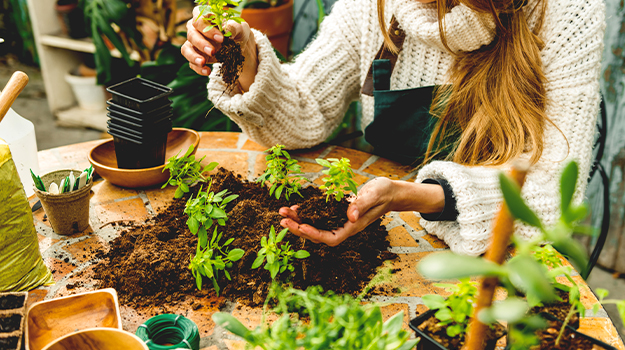
Each seedling holds the promise of a bountiful plant that will produce abundant flowers and/or fruit throughout the growing season. Pricking out is the pivotal step that transforms a fragile seedling into a vigorous, well-rooted plant, ready to face transplanting and fulfill its promise in the garden.
What is the difference between pricking out and transplanting?
Pricking out is the act of moving a seedling that has germinated with others (in a seed tray, for example) into an individual pot filled with fresh, aerated potting mix. The aim is to give the roots room to develop and produce a stronger, bushier plant.
Transplanting is defined as the act of installing a well-formed plant in its final container or in open ground, and aims to ensure rapid and stress-free recovery.
When to prick out seedlings?
Seedlings are usually pricked out about 4 to 6 weeks after germination, once the young seedlings have 1 or 2 pairs of true leaves. Other signs indicate that the young plants are ready to be moved to individual pots: the roots are visible below the tray, the seedlings are touching and the stems are elongating.
In any case, it is better to prick out seedlings a little too early than too late, because the roots will be tangled (in a bun) and risk being damaged during handling.
Not sure if it's the right time to prick out your seedlings? Consult the pricking out calendar for your hardiness zone. It suggests sowing, pricking out and transplanting dates for the main vegetables grown from seed.
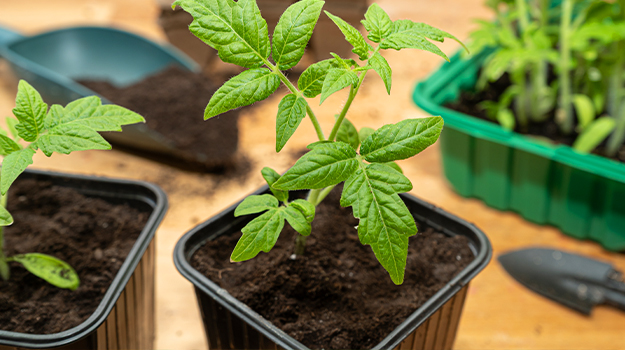
Tools and growing medium that make the difference
- 7-10 cm pots with drainage holes or cell trays
- Trowel
- Labels
- Water bottle with spray nozzle
- Lightweight, well-draining growing medium containing perlite, such as our Premium Potting Mix or our Seed Starting Mix.
How to prick out seedlings in 7 easy steps
- Fill small pots with a slightly moistened, high-quality seed starting mix.
- In the centre of each pot, make a hole large enough to insert the seedling without damaging its delicate roots.
- Extract the seedling by holding the cotyledons, not the stem.
- Adjust the planting hole depth. When planting tomato and pepper seedlings, in particular, plant below the base of the first true leaves to promote the growth of new roots that will help strengthen the plant. Other plants (flowers, herbs and most other vegetables) should not be planted any deeper.
- Add potting soil to fill the hole, then press lightly.
- Watering should be sufficient so that the water drains through the drainage hole. If necessary, add more soil.
- Provide appropriate care to pricked-out plants: bright light for 14 to 16 hours per day, temperature between 18 and 21 °C, ensure that air can circulate between the plants.
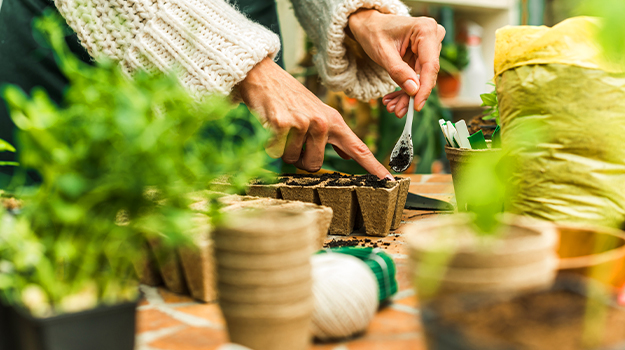
What are some common mistakes when pricking out seedlings?
To avoid disappointments in the garden, here are the most common mistakes when pricking out seedlings and how to avoid or correct them before it’s too late.
1. Pricking out too late
- The result: spiraled roots and stunted growth.
- How to correct it: gently untangle the root ball, lightly pinch the tips.
2. Removing the plant from the germination tray by pulling it by the stem instead of the cotyledons
- The result: a crushed stem, a wilting plant and risk of death.
- How to proceed: always lift the plant by the cotyledons or growing medium clump. Use a trowel or a spoon to loosen it up.
3. Packing the growing medium too tightly
- The result: poor drainage and suffocated roots.
- How to correct it: choose a light mix and avoid compacting it around the roots.
4. Watering excessively after pricking out
- The result: yellowing seedlings, root rot, damping-off.
- How to proceed: after pricking out, water until it drains from the drainage holes; then, water only when the surface is dry to the touch.
5. Planting too deeply (except for the plants listed above) or too shallowly
- The result: the crown of the plants rots when buried, and the plants are unstable.
- How to proceed: except for vegetables like tomatoes, which are planted deeper, avoid burying the crown of the plant; always replant so that the soil is at the same level as in the previous container.
6. Using a heavy and insufficiently aerated growing medium
- The result: the soil is compacted and water stagnates.
- How to correct this: use our Seed Starting Mix or an aerated growing medium with excellent drainage, such as our Organic Vegetable & Herb Mix, which contains sphagnum peat moss, peat humus, perlite and coir.
7. Lack of light
- The result: leggy, spindly stems and small, pale leaves.
- How to correct this: move the seedlings closer to the light source or use grow lights to ensure they receive 14 to 16 hours of bright light.
8. Inadequate temperature
- The result: slow growth or spindly stems.
- How to correct this: aim for a temperature of 18 to 21 °C after pricking out; avoid significant differences between daytime and nighttime temperatures.
9. Fertilizing too early or overfertilizing
- The result: root burns, browned leaves.
- How to proceed: follow our recommendations for when and how to fertilize seedlings.
10. No ventilation
- The result: weak stems and a risk of foliar diseases.
- How to correct this: ensure gentle daily air circulation; you can also expose the stems to a gentle breeze to strengthen them.
Learn how to recognize the symptoms and fix problems related to lighting, lack of ventilation, improper watering, etc. in our other article.
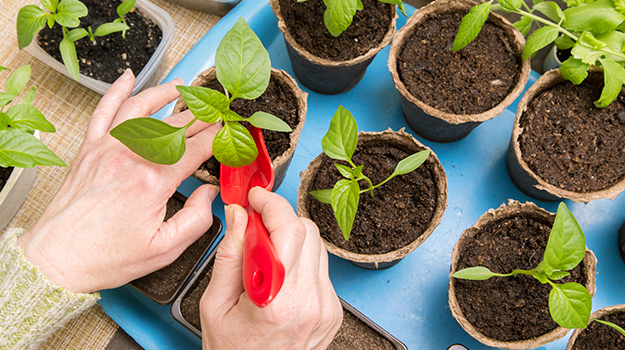
How to ensure optimal recovery in the vegetable garden
When the weather permits, your plants can be transplanted into the vegetable garden. To avoid transplant shock and potential burns, it is important to gradually acclimate your seedlings to outdoor conditions.
Allow 7 to 10 days for this process. Once finished, plant in the garden in rich soil, such as our Organic Vegetable & Herb Mix, or in a pot using a well-draining growing medium, such as our Potting Mix. For container gardening, be sure to choose a pot that is large enough to allow the plant to grow throughout the season.
To help your plants adapt to their new environment, add PRO-MIX Bone Meal BLOOMBOOST 4-10-0 to the planting hole. This slow-release organic fertilizer promotes root growth as well as more abundant flowering and fruit production. Refer to our other article for information on how much to use and how to incorporate bone meal for maximum benefit without risk of burning stems and roots.
Pro tip: Plant in the late afternoon or on a cloudy day. Do this when all risk of frost has passed and the soil is no longer waterlogged. Prepare the soil in advance, plant at the correct depth, water thoroughly – always at the base – then cover the soil with mulch, leaving the crown of the plant exposed.
Successful pricking out depends on three main factors: timing it correctly, using an aerated growing medium and providing the seedlings with optimal conditions. Prick out when the true leaves have emerged, handling them by the cotyledons, adjusting the planting depth when necessary, and then provide light, air circulation and controlled watering. Record your dates and observations. From one season to the next, your calendar will become your best ally.
Properly following these steps promotes strong root development and the growth of sturdy plants. These are the foundations for a smooth transition to the garden, rapid recovery and a more productive vegetable patch!


