

- What is maintenance pruning?
- What is rejuvenation pruning?
- When to prune Hydrangea arborescens
- When to prune Hydrangea paniculata
- When to prune standard hydrangeas?
- When to prune bigleaf hydrangea
- When to prune mountain hydrangea
- Hydrangea serrata Preziosa
- When to prune Hydrangea quercifolia
Learning that pruning at the wrong time can eliminate an entire year's blooms can be unsettling. Learning that some hydrangeas should never be pruned is even more so.
Because virtually everyone grows a hydrangea… and virtually everyone invariably prunes them at least once a year… without even considering the variety.
How and when to prune a hydrangea actually depends on the type you're growing. Here’s when and how to do it for each variety. But first, we'll explain the difference between maintenance pruning and rejuvenation pruning.
What is maintenance pruning?

Maintenance pruning consists of removing branches broken by the frost and cold and eliminating diseased wood. Poorly placed or crossed branches that will cause injuries to the shrub by rubbing against other branches are also removed. Maintenance pruning is done at the end of winter.
GOOD TO KNOW: When pruning a stem or branch, cut at an angle and always above a node.
What is rejuvenation pruning?
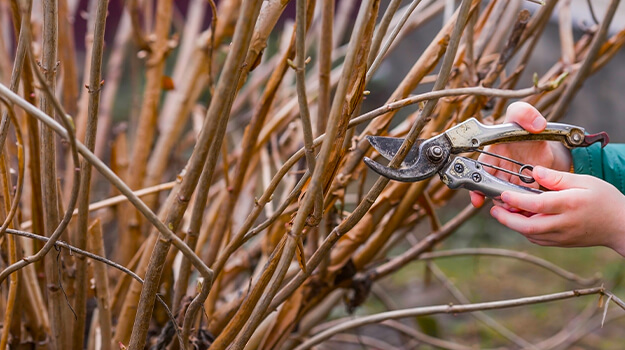
To rejuvenate a plant and encourage it to produce new, healthy, vigorous stems, you can prune every other branch, keeping a length of 5 cm.
Once you have the pruning shears in hand, you might want to take the opportunity to rebalance the plant's shape... at the risk of partially or completely eliminating the blooms to come. Before going any further, you should know that not all hydrangeas need pruning, and that those that do are not all pruned the same way or at the same time.
Learn how to easily propagate hydrangeas in our other article.
When to prune Hydrangea arborescens
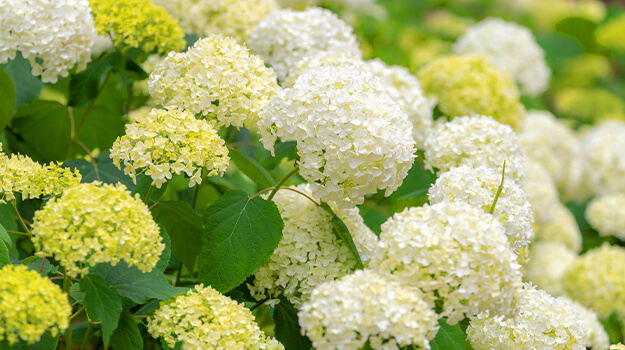
The Annabelle cultivar, famous for its enormous white, pompom-shaped flowers, is among the most widely grown smooth hydrangeas. Newer varieties, such as Incrediball® and Invincibelle®, offer good hardiness (check the hardiness zone before purchasing!), extended flowering and even cultivars with pink flowers right from the beginning.
These hydrangeas bloom on new shoots that appear in early spring. Since their flowers grow on new wood, they should be pruned to 10 to 15 cm above the ground in early spring (before the leaves appear) to encourage abundant flowering. They can also be safely pruned in the fall, since the old wood will not produce new flowers.

PRO TIP: Smooth hydrangea blooms abundantly on new stems, sometimes too frail to support its enormous pompoms. Your plant loses its appeal if, by August, too many stems (and blooms) are bent to the ground.
How can you avoid this? In early spring, instead of cutting back the branches entirely, simply cut them back by 15 cm. The flower clusters will be smaller and supported by two-year-old stems, which are much stronger. Your plant will maintain its beautiful shape all season long!
When to prune Hydrangea paniculata

Also popular in our gardens, Hydrangea paniculata is grown both in northern regions and further south. It is recognizable by its clusters of conical flowers, generally white but sometimes tinged with lime green, which take on pretty hues in the fall.
Requiring little maintenance, Hydrangea paniculata also blooms on new wood. Simply cut off the wilted flowers in late winter (the dried flowers on the shrub are of interest during the cold season). In fact, while no pruning is necessary, the shrub can be cut back to 15 cm from the ground in the fall or very early spring to encourage more compact growth.
Some varieties can reach 5 metres in height and width! Make sure you give your plant the space it needs to flourish since pruning should not be done to transform a very large plant into a dwarf variety... unless you are growing a bonsai!
If you want to control the size of your panicled hydrangea, try to keep it a normal size for a shrub (around 2 m) and you will achieve a nice balance between the size of the shrub and that of the flowers.

PRO TIP: The less you prune the shrub, the more branches you'll have, and therefore more flowers. However, these may be less impressive. On the contrary, by pruning it severely, your plant will remain small and compact, barely exceeding one metre in diameter, but it will produce gigantic flowers... often too heavy for the fragile stems that bear them.
Popular varieties include:
- Hydrangea paniculata Bobo (dwarf and compact variety offering impressive flowering)
- Hydrangea paniculata Limelight (lime green blooms in summer)
- Hydrangea paniculata Vanilla Strawberry (spectacular two-tone blooms changing from white to deep pink, then to red)
- Hydrangea paniculata Diamond Rouge (white bloom turning raspberry pink, then red)
- Hydrangea paniculata Pinky Winky (unique with the two-tone effect of its white flowers juxtaposed with pink flowers)
- Hydrangea paniculata Grandiflora (impressive white panicles)
- Hydrangea paniculata Little Quick Fire (early flowering)
- Hydrangea paniculata Phantom (huge white inflorescences that turn pink in the fall)
TIP: Panicles make excellent cut flowers. Learn how to dry them in our other article.
When to prune standard hydrangeas?
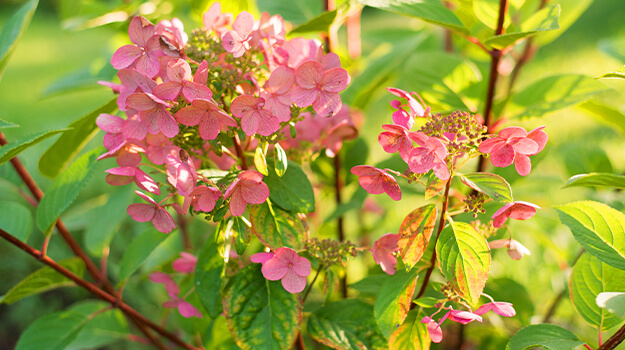
The standard varieties grown on stems are panicled hydrangeas whose branches were gradually removed so as to form a tree.
Not only can they be pruned, but it is also recommended to do so in order to maintain the shape and structure of the plant. Standard hydrangeas are pruned on their stems in early spring since they flower on new wood like other Hydrangea paniculata. There is no risk of eliminating future blooms.
Shorten the stems you want to keep by pruning them just above a bud. This will encourage the growth of new stems that will produce flowers. Branches you want to keep can be cut back to a length of 20 cm. This pruning helps limit growth and prevents the weight of snow from breaking the branches the following winter.
Remove all shoots at the base and on the trunk to keep the shape of a tree.
When to prune Hydrangea macrophylla (or bigleaf hydrangea)
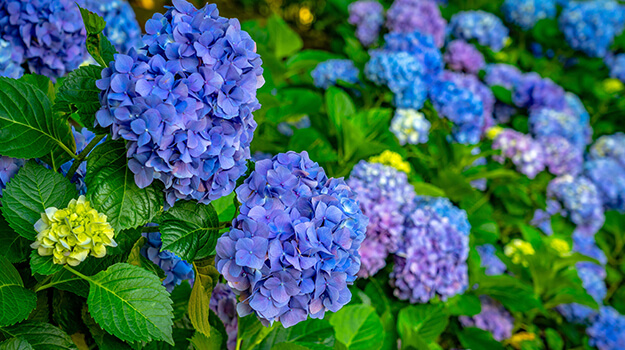
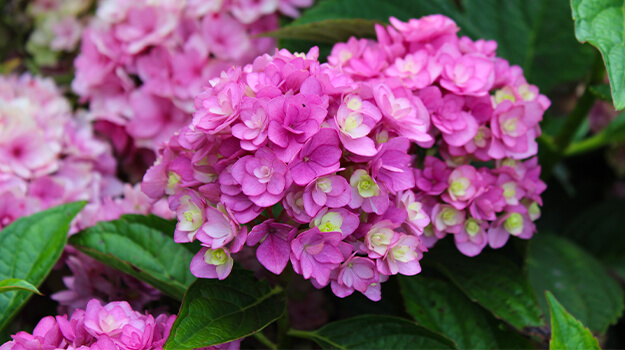
It's impossible to resist the incomparable blue flowers of this hydrangea! Blue... or pink... because in fact, the colour of Hydrangea macrophylla flowers is determined by the pH of the soil. Thus, the same hydrangea will have pink flowers when grown in alkaline soil (pH above 6.8), blue when grown in acidic soil (pH below 5.5), and blue and pink in neutral soil.
Learn more in our other article.
It is especially important not to prune Hydrangea macrophylla in the fall since this variety flowers on old wood (two-year-old wood). By pruning the branches in the fall, even slightly, you will remove the flower buds for the coming year. Pruning is therefore limited to cleaning up in the spring.
In areas where it is hardy, in early spring, you will only need to cut off old, damaged branches at the base, or dead branches in the centre of the plant. You can also remove wilted flowers by cutting them just above the first pair of buds. This is not necessary, however, since the dried flowers will fall off on their own when the plant resumes growth.

In northern regions, Hydrangea macrophylla, which is zone 6b, has difficulty withstanding winters and spring frosts. A late frost in May will even kill its flower buds, which is why it must be well protected, until late spring. Clean-up pruning should be done in May or June, depending on the region, when the winter protections are removed.
To thin out the plant and keep it flowering, you can remove a third of the old branches each year by cutting them at the base. This will encourage the growth of younger, more vigorous and more floriferous stems. Do this in early spring or late winter, before the leaves appear.
The most appreciated hydrangea varieties
- The Endless Summer Collection (better hardiness and multiple blooms throughout the season... varieties to try: Summer Crush®, Let's Dance Blue Jangles®, Pop Star®)
- Twist-n-Shout® (flat, spectacular pink or blue flowers and colourful stems)
- Penny Mac (considered the best bigleaf hydrangea for northern climates)
- All Summer Beauty (a repeat-flowering variety that blooms once on old wood, then a second time on new wood)
- Blushing Bride (repeat-flowering that turns light pink)
- Mousmee (bright pink inflorescences that turn blue-purple depending on the acidity of the soil)
- Alpenglühen (flowers over 20 cm in diameter, cream and pink to crimson red (or rather lilac in more acidic soil))
- Alpenglow (large flowers with a fabulous purple tone in acidic soil)
What’s the best winter protection for hydrangeas?
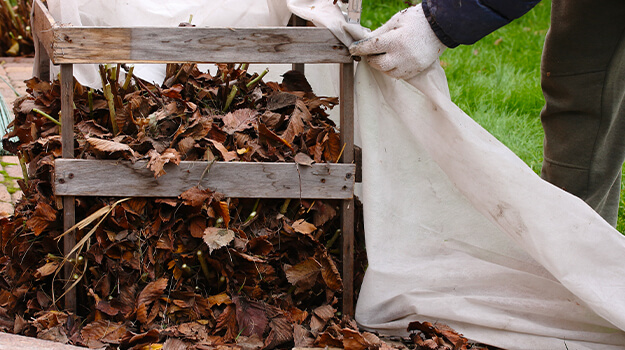
Grow Hydrangea macrophylla in partial shade, in a sheltered spot, and in rich, deep soil. It can flower in zone 4 if given good winter protection.
In zones below 6b, once the leaves have fallen in the fall, surround the hydrangea with a wire fence and fill it with dead leaves to cover all the branches. Leave the protection in place until the end of May in zone 5 or mid-June in zone 3 or 4. The plant will not wake up until the leaf mulch is removed, and the flower buds will thus be preserved. This is also the time to remove dead wood.
When to prune Hydrangea serrata (mountain hydrangea)
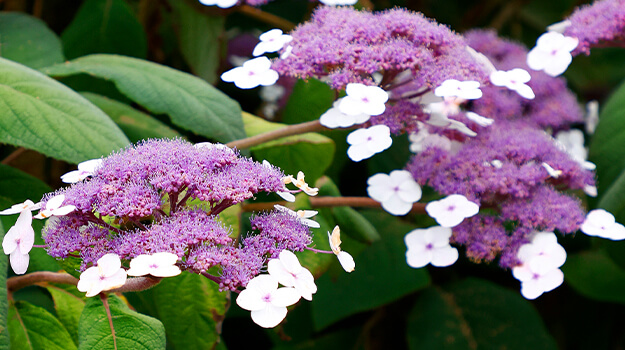
Mountain hydrangea blooms on old wood. This means that any heavy pruning in spring or fall will compromise its blooms. This explains why this highly floriferous and virtually maintenance-free plant tends to disappoint pruning enthusiasts.
IN THE SPRING: Remove only dead or winter-damaged branches. Cut broken branches above a pair of buds. This pruning is necessary both for aesthetic reasons and to keep your plant healthy. Although hydrangeas are relatively resistant to insects and diseases, an opening in the wood is an entry point for both.
Don't prune further. Pruning your shrub to give it a nice shape at this time will remove some or all of the flower buds. Luckily for us, Hydrangea serrata is a shrub that maintains its shape as it grows, so you'll rarely need to trim it.

IN THE FALL: Once flowering is complete, you can cut off the wilted flowers above the first pair of buds. This pruning is optional, however. Dried flowers look beautiful covered in snow and will disappear on their own in spring. However, it is recommended to cut off large flowers to prevent branches from breaking under the weight of the snow.
At the same time, you can, if necessary, shorten the branches that have flowered, but you risk ending up with an unbalanced shrub. There are sometimes good things about letting nature take its course!
GOOD TO KNOW: Hydrangea serrata can be more sensitive to frost. Applying a good layer of mulch around its base is highly recommended.
The most appreciated Hydrangea serrata
- Golden Sunlight (golden foliage)
- Tokyo Delight (white blooms)
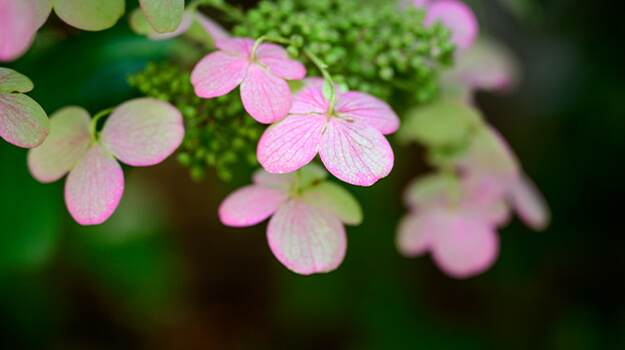
- Cap Sizun (delicate, serrated flowers, lavender blue or powder pink, hardy, ideal for the seaside)
- Mont Aso (light green foliage that colours in the fall, flowers with changing colours, from pink to purple)
- Tuff Stuff Ah-Ha® (repeat-flowering variety and considered the most spectacular with its flowers resembling water lilies)
- Pink Dynamo™ (breathtaking with its bright pink flowers that contrast with its almost black foliage)
Hydrangea serrata Preziosa

Although Hydrangea Preziosa is a mountain hydrangea, it looks more like Hydrangea macrophylla. Its stems and leaves are smaller, but it has the advantage of being more hardy (zone 5a) and is therefore a good option for northern regions, although it is recommended to protect it in winter.
How to protect Hydrangea serrata Preziosa in winter
Winter protection isn't mandatory, but it does ensure more abundant flowering. Like Hydrangea macrophylla, it should be surrounded by a wire mesh fence filled with dead leaves.
Like all mountain hydrangeas, Preziosa blooms on old wood. It is therefore never pruned in the fall. In the spring, simply cut back dead or winter-damaged branches, as more severe pruning would eliminate future blooms. Once the flowers have dried, if the shrub is irregular in shape, you can prune lightly by cutting just above a pair of buds.
When to prune Hydrangea quercifolia

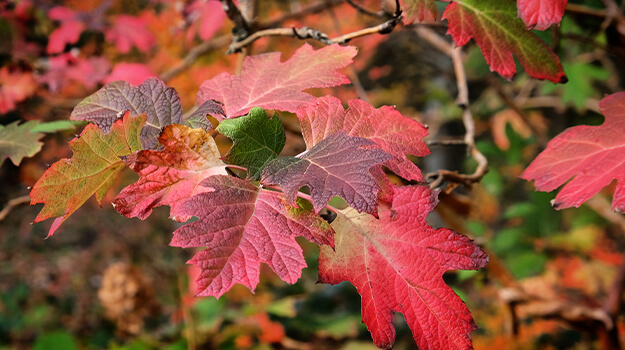
Hydrangea quercifolia is also called "oakleaf hydrangea" because its leaves resemble those of an oak tree. Don't be fooled, though. While many oak varieties offer a late and rather dull fall colouration, Hydrangea quercifolia’s is quite the opposite.
Many people grow it for its foliage, which turns red, purple and orange in the fall. While Hydrangea quercifolia's flowering isn't always reliable in northern regions, its foliage offers an exceptional sight... especially for a hydrangea!
No pruning is necessary for oakleaf hydrangea. In early spring or late winter, simply remove dead or frost-damaged wood. However, it is possible to prune to 20 cm from the ground to rejuvenate an old shrub that has become too large over time. This should be done in late fall, after flowering. Then, be patient, as it may take time for the plant to fully recover.
TIP: To maintain a dense and harmonious shape, pinch the tips of young stems so that they branch out.
Discover how to prune a climbing hydrangea in our other article.


