

- What is a climbing hydrangea?
- Where to plant a climbing hydrangea?
- Should I water a climbing hydrangea?
- How do I fertilize a climbing hydrangea?
- Should I prune a climbing hydrangea?
- How can I cut back a hydrangea that's growing too tall?
- How tall does a climbing hydrangea grow?
- Do climbing hydrangeas grow fast?
- Do climbing hydrangeas damage walls?
- Which climbing hydrangea should I choose?
What is a climbing hydrangea?

Easy to grow and spectacular, climbing hydrangea is little demanding and blooms abundantly. Once established, it requires minimal care. And because its aerial roots attach delicately to the walls they are grown on, it does not cause damage to structures, provided they are strong enough to accommodate it.
Where to plant a climbing hydrangea?

Climbing hydrangea thrives in a partially shaded or shaded location, ideally sheltered from the wind. Once mature, its older stems become woody and rigid. While a strong wind can easily knock young stems off the wall, larger branches are prone to breakage.
When planting, provide deep, fertile, cool and moist soil. You can also plant hostas at its foot to shade the soil and prevent it from drying out too quickly. You should also ensure that the soil is well-drained to make sure its roots stay healthy.
Smaller varieties can be grown in pots or trained against a wire trellis, screen or arbour. Larger varieties will need a sturdy support, such as a wall or arbour.
Climbing hydrangea requires a neutral pH. The colour of its flowers, initially pale green and then white, does not change depending on the acidity of the soil, as is the case with other hydrangeas.
Should I water a climbing hydrangea?
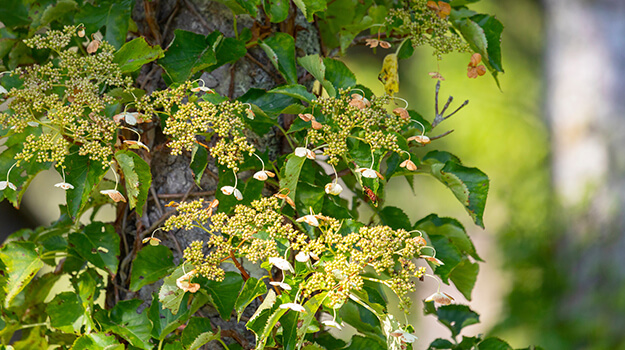
Water your climbing hydrangea regularly during the first year to encourage root establishment. Afterwards, it will mostly need water during periods of drought or intense heat. Water at the base and avoid wetting the leaves and flowers to prevent fungal diseases.
The watering frequency will depend on the weather. Climbing hydrangeas prefer soil that is constantly moist, but never soggy. Before watering, check the moisture level by sticking your finger in the soil.
How do I fertilize a climbing hydrangea?
When planting, mix the soil with a quality soil mix that drains well, like our All Purpose Mix, and then add compost. In the first year, add PRO-MIX ROOT BOOSTER to the irrigation water to accelerate root development (climbing hydrangeas can take time to establish).
Every spring, add compost at the base of the plant and use an organic fertilizer that is low in nitrogen but high in phosphorus and potash to encourage flowering. Our suggestion: PRO-MIX Organic-based Garden Fertilizer 9-16-16.
Should I prune a climbing hydrangea?
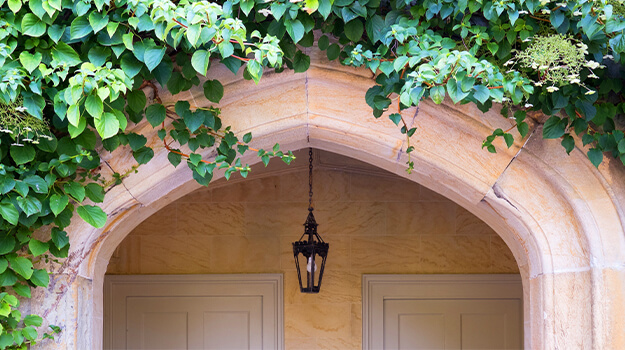
With its sturdy stems that become woody over time, climbing hydrangea is a vigorous plant that clings to walls, fences and the like by means of aerial roots.
Some varieties bloom on both old wood and new stems, allowing you to enjoy two flowerings in a single season. Therefore, limit yourself to removing poorly placed or winter-damaged stems in the spring. Don't even bother removing wilted flowers, as they protect the dormant flower buds just below.
However, it is recommended to prune the tips of the branches or guide the still malleable stems so that the plant does not become too invasive and remains away from doors, windows, etc.
How can I cut back a hydrangea that's growing too tall?
To prevent your climbing hydrangea from spreading beyond the roof or structure it's growing on, you can reduce its height by pruning the tips of the branches in the spring. Since flowers grow on both the terminal and secondary branches, pruning the highest branches won't really affect the overall flowering of a mature plant.
If your structure is low and your plant is still young, you can prune the highest branches, which encourages denser growth, or redirect some branches to the sides to gain width.
How tall does a climbing hydrangea grow?
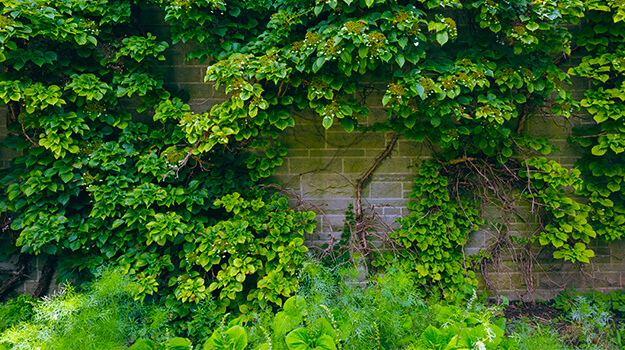
Climbing hydrangea blooms profusely from early summer onwards, requiring no maintenance. Once established, some varieties can reach a height of 4 to 5 metres (sometimes up to 15 metres depending on the variety and growing conditions). It can also spread to a width of 3 to 5 metres.
For the first two years, a stake can be used to guide the young stems to climb upwards.
Do climbing hydrangeas grow fast?
Climbing hydrangea can take up to three years to establish itself. Its growth is therefore rather slow at first, as the plant devotes its energy to developing a strong root system. Avoid pruning it during this period. Afterwards, its growth will be rapid and vigorous.
Do climbing hydrangeas damage walls?
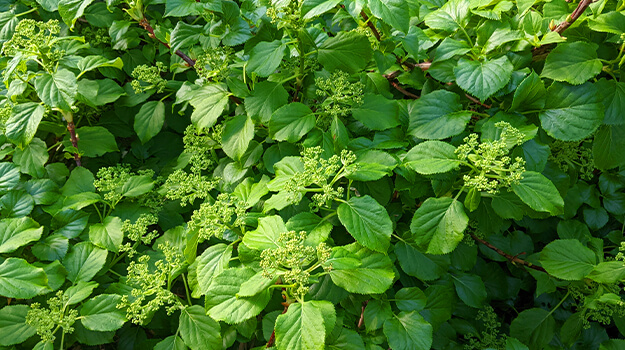
Climbing hydrangea, like many plants grown on walls, poses no risk to structures in good condition. It does not have aggressive roots that could insert themselves between bricks and pull them loose. Instead, its aerial roots gently attach themselves to the surface without damaging it.
Better still, the presence of climbing plants can protect the wall from the sun and bad weather, and help regulate the temperature inside the building.
However, before planting, make sure the mortar joints are in good condition. Hydrangeas don't penetrate walls, but when mature, their weight can put pressure on the structure.
If the joints are brittle or the brick is cracked, it's best to avoid planting. While they won't cause any direct damage, the presence of climbing plants will keep the wall more humid and impede ventilation.
Which climbing hydrangea should I choose?

The most widely grown climbing hydrangea is Hydrangea petiolaris. It is hardier and denser than other varieties, but it loses its foliage in winter.
Hydrangea seemanii keeps its foliage in winter. However, it is less resistant to the cold and has difficulty surviving temperatures below -8 °C.
Halfway between the two, the SEMIOLA® hydrangea keeps part of its foliage in winter and can survive temperatures as low as -15 °C.
