
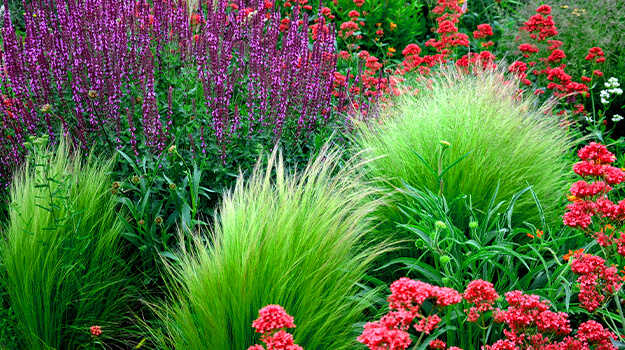
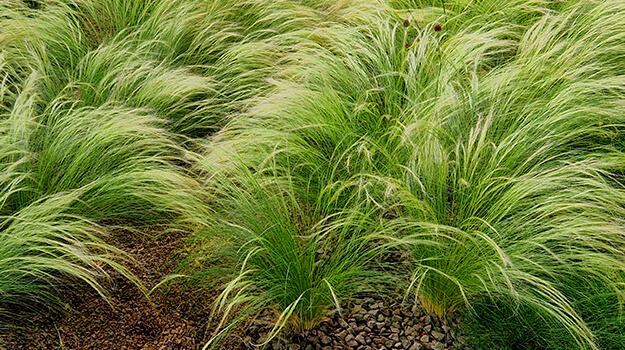
Stipa is also known as “feather grass” because of its beautiful colour and appearance, which are unmatched when it comes to adding softness and movement to the garden. Versatile and easy to care for, it can be planted in repeating groupings to create a beautifully airy landscape.
How to use stipa in the garden
The plant is also particularly beautiful when grown in containers, and its flower heads add a stunning touch to any bouquet of fresh or dried flowers.
Although stipa can be grown on its own, either in the ground or in containers, it is often paired with other perennials to create airy, dynamic and highly graphic plantings. It can be combined just as beautifully with flowers borne on long, flowing stems as with plants featuring more rigid foliage and structured shapes.
With its natural elegance, stipa can be used in both formal landscapes, such as modern gardens and dry gardens, and informal settings, such as wildflower meadows and English gardens. It can also be planted along a walkway, used to conceal a home’s foundation, surround a patio or serve as a boundary between two properties.
Finally, thanks to its dense root system, stipa helps reduce erosion on slopes. Since it requires virtually no maintenance, it is an excellent choice for steeper areas that are difficult to access.
What plants pair well with stipa?
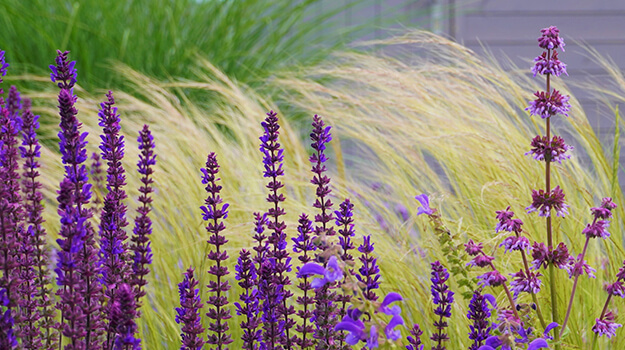
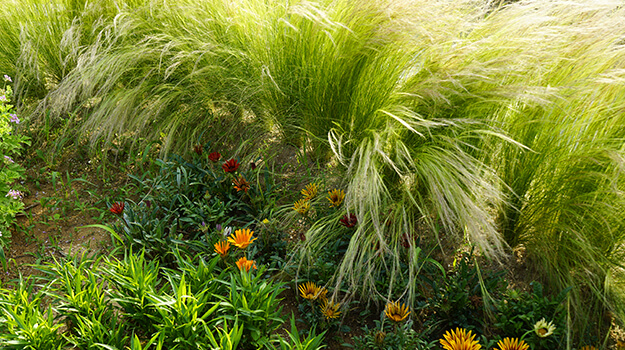
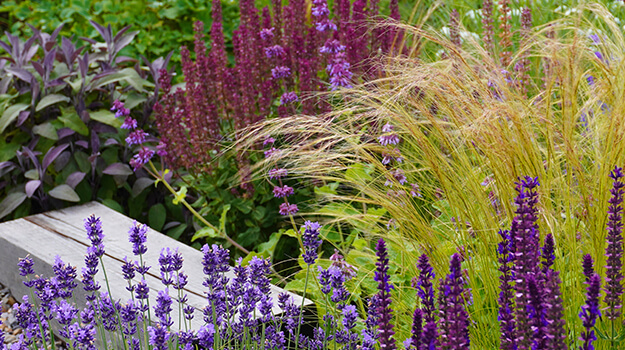
Paired with flowers in soft hues, stipa creates wonderfully delicate plantings. It can just as easily be combined with brightly coloured flowers to create striking contrasts. For a spectacular planting, here are a few pairing ideas:
Perennials, annuals and bulbs to pair with stipa
- Coneflowers
- Irises
- Gaura
- Verbena bonariensis
- Crocosmias
- Delphiniums
- Japanese anemones
- Russian sage
- Hostas
- Lavender
- Miscanthus
- Centaureas
- Sea hollies
- Agapanthus
- Santolina
- Asters
- Dahlias
- California poppies
- Saxifrages
- Pennisetums
- Blue fescue
The best choices for a Mediterranean-style garden
- Agaves
- Yuccas
- Rosemary
- Sages
- Gardenias
- Bougainvilleas
The best shrubs to pair with stipa
- Silverthorn
- Butterfly bush
- Rugosa roses
- Sea buckthorn
- Hydrangeas
- Elderberry with serrated foliage
- Serviceberry
- Crape myrtle
- Rockroses
- Hibiscus syriacus
Where to plant stipa
Stipa can tolerate a slightly shaded location, but for a full, lush plant and abundant flowering, choose a spot in full sun. Its foliage will also be more vibrant.
Stipa thrives in heat and is not bothered by wind or salt spray. It can easily be grown in poor, dry and rocky soil, as long as it is well drained. Soil that remains waterlogged in winter can be fatal to the plant.
When to plant stipa
You can plant stipa in spring, from March to June, or in fall, from September to October or November, depending on the region where you live. Fall planting is often recommended, but in areas with harsh, wet winters, it is best to plant in spring so that your ornamental grass has time to become well established before the cold weather arrives.
For good establishment, soak the root ball before planting it in a hole that is two to three times larger than the root ball.
Tip: Add a thick layer of gravel to the bottom of the planting hole to improve drainage.
How to water feather grass
Water stipa for a few weeks after planting to encourage healthy root development. Once established, this ornamental grass is highly drought-tolerant and requires very little watering, except during prolonged periods of drought.
Does stipa need to be fertilized?
Stipa does not need to be fertilized, as the plant grows best in poor soil. Since adding compost or organic fertilizer can be beneficial at planting time, you can mix our All Purpose Mix with the existing soil. The fertilizer it contains will be sufficient, while its peat-based composition will improve soil quality and drainage.
Caution: Too much fertilizer, particularly a nitrogen-rich formula, can reduce the plant’s natural hardiness and negatively affect flowering.
When and how to prune stipa
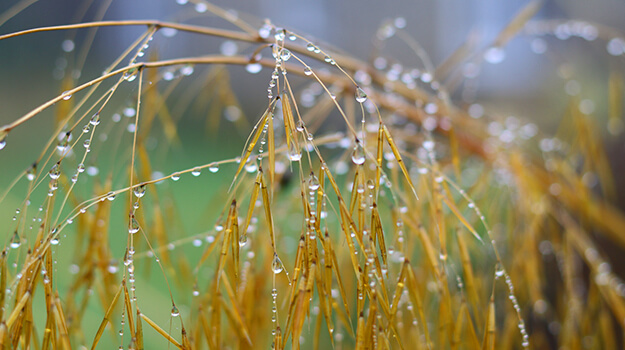
Stipa does not really require pruning. Minimal maintenance consists simply of combing through the plant at the beginning of the season to remove dead leaves. Cutting back the stems at the end of winter helps the plant maintain an attractive shape year after year. Cutting the dried foliage back to ground level encourages new, vibrant green growth.
How to propagate stipa
The lifespan of Stipa tenuifolia is relatively short, at around 4 years, but other varieties, such as Stipa capillata, are more long-lived. The latter is also hardier (zone 4).
Stipa can be propagated from seed. In fact, in sufficiently warm regions, it often self-seeds. However, it is very easy to propagate by dividing the clump in early spring or fall, after flowering.
What winter protection does stipa need?
Several stipa species are hardy, and evergreen varieties are especially valuable for adding year-round interest to the garden. Since the plant is only cut back in spring, if at all, its foliage helps protect the roots from the cold during winter, as does a thick layer of mulch around the base (7 to 10 cm).
In northern regions, choose hardy species such as Stipa capillata, Stipa gigantea and Stipa tenuissima Pony Tails. Some less hardy species may benefit from winter protection provided by conifer branches.
Learn more about stipa in our other article.
