
Some people think you have to wait until the end of spring to sow or plant outdoors. However, some flowers and herbs can be sown early in the season. Similarly, unlike tropical vegetables such as tomatoes and peppers, many seeds tolerate the cooler temperatures of spring well.
In fact, some plants only thrive in cool weather and suffer from the summer heat. Others can be sown early and planted successively, thus allowing for a second or even a third harvest. So why not do it?
Why direct sow?
Economical compared to buying plants, and even indoor sowing (no need for indoor starting equipment such as lights, trays, etc.), direct sowing is done directly in open ground in the garden.
Direct sowing is easy and requires no acclimatization. The seedlings’ growth is continuous; they don't need an adaptation period like those started indoors. The seeds germinate and develop in real-world conditions (soil, light, moisture), which promotes the formation of better-adapted plants. They generally develop deeper roots than transplanted plants, improving their vigour and resistance to drought.
As is always the case with seeds, you have access to a wide selection of varieties not offered at the garden centre. And when it comes to flowers, you can find unique colour combinations, making it easy to create dense flower beds, impressive borders or wildflower meadows that attract pollinators.
When to start vegetable seedlings outdoors?
That depends on your region’s usual date of last frost. For most Canadian regions, that last frost could occur in late May to early June. The exceptions are in Southern Ontario, where the last frost date is a little earlier, say mid-May. In British Columbia’s Lower Mainland and Vancouver Island, the last frost can be a month earlier in mid-April.
And obviously, in the United States, while some regions have climates similar to those of Canada, others benefit from mild temperatures that allow for sowing 12 months a year.
This last frost date is a benchmark for your frost-tender seeds and tropical transplants like tomatoes and peppers. This is the time frame that many backyard gardeners consider to be the start of the season.
Appropriate seeds can be sown when soil temperatures reach 4-10 °C and the ground is no longer frozen, waterlogged or sticky. Look for indicators that include the ability to form a ball of soil that crumbles easily, consistent morning soil temperatures and the leafing of shrubs.
To find out the estimated date for sowing the most commonly grown vegetables outdoors, also consult the calendar for your hardiness zone.
What vegetables can you plant?
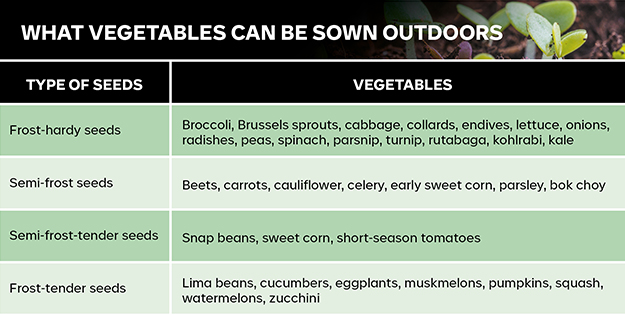
Working backwards from your particular region’s last frost date, consider that frost-hardy seeds can be planted 3-4 weeks before the last frost date. Semi-frost seeds can be planted 2-3 weeks before, and semi-frost-tender seeds 1-2 weeks before the last frost date. There are many seeds that can tolerate a little frost.
Tip: Succession planting involves planting a small row early (e.g., mesclun mix lettuce or spinach), followed three weeks later with another small row, and again another one before the hot summer. Instead of being inundated with lettuce all at once, you can have manageable mini harvests.
Weather alert: can seedlings recover from frost?
Sometimes when you plant seeds early, you might get hit with a hard frost or even snow. Some of the seeds might die in the ground; others will be fine. There are loads of seeds in a seed packet. Simply re-seed. Nothing is lost trying to start early.
After the last frost, you can plant the vegetable seedlings that you have started indoors or bought at a garden centre at the same time as your frost-tender seeds.
What flowers to sow outdoors at the beginning of the season
Direct sowing in the garden is also suitable for many fast-growing annual flowers, including those that dislike being transplanted. Reliable choices include calendula, nasturtium, sunflower, cosmos, cornflower, poppy, love-in-a-mist and zinnia.
Some of these flowers can be started from indoor seeds, but for those that tolerate cooler temperatures and are sown early, the longer flowering period is barely noticeable. When sown directly in the garden, in rich soil and optimal conditions, they germinate, grow and bloom quickly.
The best flower varieties to sow in zone 3
Very early sowing is possible for calendula, cornflower, nigella, California poppy, phacelia, alyssum, lobelia (surface sowing), clarkia, annual larkspur.
Wait until the soil is warm before sowing zinnia, sulfur cosmos, nasturtium, French marigold, sunflower.
The best flower varieties to sow in zone 5
In addition to being able to sow the same flowers as in zone 3 very early, it is possible to stagger cosmos, zinnia and love-in-a-mist sowings.
Sow these flowers two or three times over a period of 10 to 14 days to enjoy a prolonged bloom.
The best flower varieties to sow in zone 7
The soil warms up quickly, which is perfect for sowing zinnia, cosmos, nasturtium and French marigold. Protect the seedlings from drying out too quickly by applying a light mulch, watering as needed and providing light shade for plants that are less tolerant to heat.
For cool-loving species such as calendula, larkspur and love-in-a-mist, sow early in spring or fall (or late winter) for spring flowering.
Which aromatic herbs can be sown directly in the garden?
Here are the aromatic herbs that are suitable for direct sowing in the garden, with their preferences and the slight differences to be aware of when growing in a northern region or in a milder climate.
In northern regions (zones 3, 4 and 5), these herbs tolerate the cold and can be sown early in spring, in cool soil:
- Dill: sow seeds every 2 weeks.
- Coriander: sow in succession and provide light shade in summer to delay bolting.
- Chervil: sow in moist soil, ideally in partial shade.
- German chamomile: sow on the surface.
- Black cumin (Nigella sativa): do not sow densely.
- Parsley: soak seeds for 12 to 24 hours before sowing and keep the soil moist.
- Chives (perennial): slow growth in the first year; thrives in sun or partial shade.
Herbs to sow once the soil has dried:
- Lemon balm (perennial): very easy to grow and tends to spread.
- Thyme (perennial): sow on the surface in a sunny location with well-drained soil.
- Oregano (perennial): sow on the surface in a sunny location with well-drained soil. In zone 3, sowing is possible but slow; mulch is necessary in winter.
Herbs to sow in the garden once the soil has warmed up (late spring/early summer):
- Anise: sow in a sunny, well-drained location; a very sheltered spot is best in zone 3.
- Sweet fennel: sow in rich, moist soil.
- Basil: sow when the soil temperature reaches 18 °C; mulch to protect from intense heat; staggered sowing is possible; results are not guaranteed in zone 3.
- Annual savory: sow in a warm and dry location.
- Borage: sow as soon as the soil has warmed up.
In warmer regions (zone 7 and above), springs are short and hot. If you wish to sow herbs directly in the garden, you must do so very early in the season or even in the fall.
Aromatic herbs to sow very early in spring, before the intense heat:
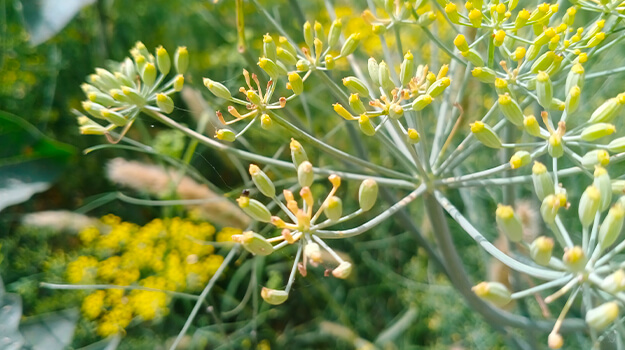
- Dill: sow early and can be resown at the end of summer.
- Coriander: sow very early in spring and/or fall; prefers partial shade in summer.
- Chervil: sow very early in spring and/or fall; prefers partial shade in summer.
- German chamomile: sow early on the surface.
- Black cumin (Nigella sativa): sow very early in spring and/or fall.
- Parsley: sow very early in spring and/or fall; keep moist for germination.
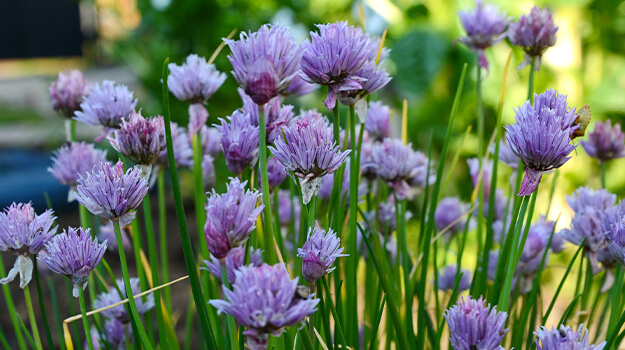
- Chives (perennial): sow in spring; easy and reliable.
- Lemon balm (perennial): sow in spring; easy to naturalize.
- Thyme (perennial): sow in spring, in full sun and very well-drained soil.
- Oregano (perennial): sow in spring, in full sun and dry soil.
The following aromatic herbs tolerate the heat well and can be sown later, once the soil has warmed up:
- Basil: sow as soon as the soil temperature exceeds 18–20 °C; protect from drought at the beginning.
- Anise: thrives in warmth but avoid heat waves during germination.
- Sweet fennel: likes warmth but may go to seed if it is too hot or dry; water regularly.
- Annual savory: prefers poor, dry soils.
- Borage: easy to sow in zone 7.
Tip for growing fresh seasonal herbs in hot climates
To grow aromatic herbs that like cool temperatures (coriander, chervil, dill, chamomille, parsley), sow at the end of summer or the beginning of fall to harvest before winter, or at the beginning of the following spring, depending on the climate.
Consult our guide to learn more about sowing aromatic herbs, or to find out when to sow them indoors.
Tips for successful direct sowing
Here are 6 key points to remember, whether you’re sowing edible plants or flowers:
- Prepare a fine seedbed, previously weeded, and lightly firm the soil after sowing.
- The planting depth is usually 2 to 3 times the seed diameter, unless otherwise specified, such as for surface sowing.
- To avoid disturbing the seeds, water with a fine spray.
- The seedbed must be kept consistently moist until germination. Once the seeds have germinated, water more deeply but less frequently.
- Thin at the appropriate time to ensure vigour, provide good aeration, limit competition, and promote flower and fruit production. Respect the recommended spacing between plants.
- Once the seedlings have emerged, mulch the soil (especially in zone 7) to keep it cool, limit water evaporation and suppress weeds.
The success of outdoor sowings is practically guaranteed, without requiring any significant time or energy investment. This high success rate is primarily due to the ease of controlling the environment, thus providing optimal starting conditions. You can now begin dreaming of a more vibrant and productive garden!
If you are looking for other ideas to enjoy a more productive garden, learn how to do successive sowings in our other article.
