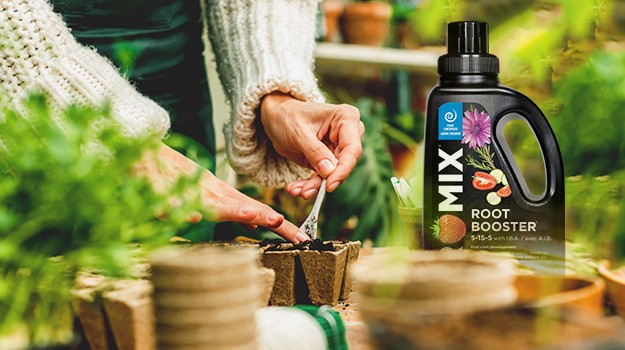
Making sure your plants get the best start possible is essential whether you’re planting shrubs, trees or perennials, or putting out annual transplants in the spring.
But all plant foods are not the same. Before your new plant can establish itself, it needs to recover from the shock of being moved from its confining growing pot to your new environment, and it must expand its roots into your soil.
Understanding N-P-K: why the right balance matters for new plants
Fertilizers have 3 numbers on the package, like 5-15-5. The first number is nitrogen, which encourages leafy top growth. The second is phosphorus, which enhances root development, and the third number is potassium, known for building up stress tolerance.
The last thing a new plant needs is high nitrogen at this point. A lot of nitrogen during the planting stage will discourage root development and promote unwanted leaf growth at this stage. Also, if the high nitrogen component comes into direct contact with the exposed roots, it can burn them.
At this point, what your new plant needs is a low-nitrogen starter product with high phosphorus boosted with a rooting hormone, like ROOT BOOSTER 5-15-5. These components will encourage new root growth, not top growth.
When should I use a root booster?
Unlike common growth fertilizers, a good starter fertilizer’s composition contains more phosphorus than any other nutrient. It should contain some potassium to increase the plant’s resilience and a bit of nitrogen. A typical starter has a 1-3-1 ratio, such as 5-15-5. In addition, the ideal starter would include a rooting hormone such as IBA (Indole-3-Butyric Acid), which “nudges” your plant to work on root initiation.
These are the key benefits to using a plant starter fertilizer with IBA.
- Encouraging the plant to focus on pushing out new feeder roots immediately.
- Causing the roots to stretch deep into the soil to look for moisture and vital minerals, establishing its water and nutrient supply faster.
- Minimizing the vulnerability to wilting.
- Having phosphorus at the root zone along with IBA gives the plant immediate “fuel” for rapid cell division.
- Reducing transplant shock from the protected nursery environment to your outdoor garden.
- Triggering better flower formation, earlier maturity due to its stronger early root development.
Why a rooting hormone makes a difference
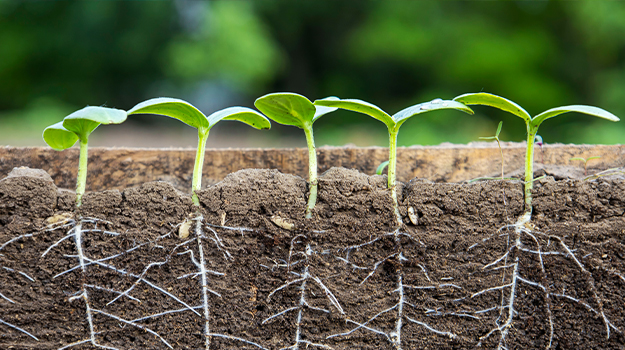
IBA provides a “kick-start” to all plants. It sends a signal to the plants to start new roots. With the phosphorus blended with the IBA, you get a synergistic partnership with the two working better together than alone.
A plant with weak and slow root development has trouble establishing, is not efficient at absorbing water and struggles overall. A plant with quick emerging healthy roots establishes faster, handles stress better and flourishes with the right growing conditions.
Which is better: liquid or granular fertilizer?
Granular fertilizers need moisture to dissolve, meaning they can sit dormant in dry soil for days. With a liquid concentrate, you dilute it with water in a pail or watering can. When it comes to transplanting, this liquid starter fertilizer is considered better, since it gives young roots an instant, accessible source of phosphorus without requiring moisture to dissolve it.
Also, in a standard spring, you have cooler soil conditions. These liquid nutrients work well in typically cooler soil. The diluted fertilizer can be poured directly into the planting hole or on the surface to ensure focused distribution.
How to use a liquid starter fertilizer
Starting seeds indoors: Seeds contain their own energy, so they do not need fertilizer during germination. Wait until the first true leaves (the second set of leaves) appear. Dilute the fertilizer to 1/4 or 1/2 the strength recommended on the label and water as usual.
Transplanting annual seedlings: Whether transplanting your seedling flowers or vegetables into containers or into the garden, pour the starter mix directly into the planting hole or soak the area well afterwards. Continue until plants are well established.
Repotting indoor plants: Whenever your indoor plants are starting to get too big for their pot and it’s time to go to a bigger size or to divide and repot them, soak the plant with a starter solution after repotting. Continue for the next month and gradually switch back to your regular houseplant fertilizer.
Plant cuttings: After your cuttings have rooted and you are going to pot them, after planting them in your potting mix, soak them with the starter solution. Continue for a month or so and gradually switch to your usual fertilizer.
Dividing perennials: Whenever you decide to divide your outdoor perennials, make sure you soak the planting holes well with a starter solution, and continue to do so during the growing season.
Planting new perennials, shrubs and trees: Pour the mixed solution directly onto the root ball, making sure that it’s thoroughly soaked before finishing backfill. After backfilling the hole, pack the soil gently to remove air pockets, and water the entire area once more with the starter solution to settle the soil. Alternatively, you can pour the liquid solution directly into the empty planting hole before setting the plant in, allowing it to soak the bottom soil. Stop any fertilizing during late summer.
Next step: choosing the right fertilizer for your plants
Once your plants are well established, you can provide them with a fertilizer suited to their needs. To make the right choice, remember that fertilizers with a high first number (nitrogen) encourage the development of the plant's green parts. Those with a high last number (potassium) strengthen the plant's overall health and resistance to disease, in addition to encouraging the production of flowers or fruits.
The other point to consider is the difference between liquid and granular fertilizers, which lies in their speed of action and duration of release. Liquid fertilizers act instantly but require more frequent applications, while granular fertilizers offer slow and continuous release.