
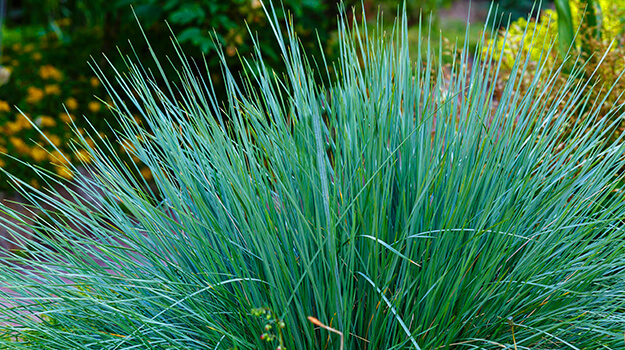
Since most ornamental fescues are blue, they are unparalleled when it comes to adding colour to the garden.
Its colour, appearance and drought tolerance make it an ideal plant for dry and Mediterranean-style gardens. Remarkably elegant, it also has a special place in romantic gardens, where it pairs beautifully with roses, sages, anemones, bellflowers and hollyhocks. It can also be combined with brightly coloured plants to create striking contrasts.
Equally beautiful on its own or planted in groups, it can be found in garden beds, rock gardens, borders and even planters.
How to use fescue in garden beds
Fescue, particularly blue fescue, can be used to create striking contrasts in garden beds and flower borders. Pair it with plants featuring silver or purple foliage, or with other ornamental grasses such as miscanthus, calamagrostis and pennisetums, to highlight a variety of textures.
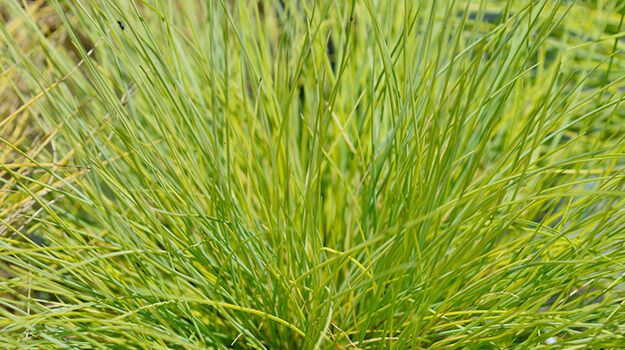
Combined with white or pastel blooms, it creates beautiful romantic landscapes. When contrasted with poppies, nasturtiums, zinnias and lilies, fescue makes for eye-catching combinations.
You can also create striking graphic effects by juxtaposing it with fritillaries, globe-shaped buddleias, crocosmias and ornamental alliums. Be sure to follow the recommended planting distances to maximize the effect.
How to use fescue in borders and rock gardens
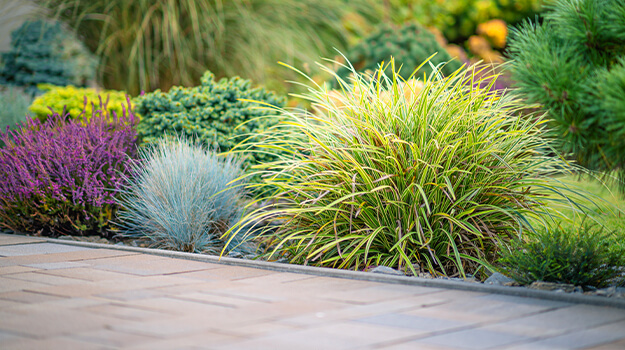
Planted repeatedly, the fescue’s round, uniform shape is ideal for edging shrub borders, flower beds, pathways and more. It looks beautiful planted in front of shrubs with white or pink blooms, or can be used to create attractive mixed borders with lavender, sage and a variety of annuals.
Fescue can also be used on its own as a focal point in a rock garden or flower bed. Its shape and colouring also pair perfectly with the mineral elements of a dry garden. Combine it with hens-and-chicks, euphorbias or sedums.
Discover more spectacular combinations with fescue here.
How to use fescue in container arrangements
Fescue can also be grown in containers. For a harmonious arrangement, pair it with other plants featuring a variety of textures, such as broad-leaved plants or more delicate ornamental grasses.
When grown in containers, fescue will need to be watered more frequently, but you can allow the growing medium to dry out slightly between waterings. Use a well-draining growing medium, such as our Premium Potting Mix.
Other benefits of fescue in the garden
Fescues attract birds and butterflies to the garden and make a beautiful addition to a pollinator garden. And because they provide shelter for small wildlife and beneficial insects, they help support a healthy ecosystem.
How to care for fescue
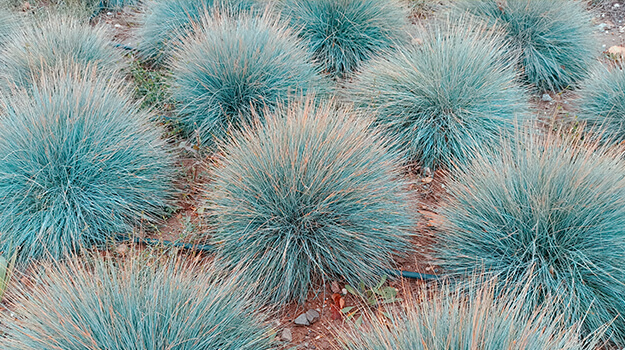
Fescue is one of the easiest and most resilient plants to grow. Once established, it requires little to no special care. Simply plant it in full sun and well-drained soil to promote vigorous growth and enjoy its beautiful colour to the fullest.
When to plant fescue
Plant ornamental fescue in spring or fall, when the soil is well drained and not waterlogged, and temperatures are moderate. Spring is preferable, however, as it gives the plant time to establish its roots before the summer heat or first frost.
What type of exposure is best for fescue
Although fescue can tolerate light shade, planting it in full sun will result in more intense colouring.
What type of soil for fescue
Very undemanding, fescues thrive in poor, rocky or sandy soil as long as it is well drained, as excess water and persistent moisture can cause their roots to rot.
Be especially careful with heavy clay soils. To provide your fescue with light, well-drained soil, dig a hole deeper than the root ball, add sand or gravel to the bottom of the planting hole to improve drainage, then fill it with a mixture of soil and sand.
Learn how to garden in clay soil.
How to water fescue
Fescue should be watered thoroughly after planting, but only occasionally thereafter. Since it is drought-tolerant, it will generally get all the water it needs from rainfall.
When to fertilize fescue
A balanced fertilizer, such as our Organic Multi-Purpose Garden Fertilizer 7-3-3 or our Organic Garden Fertilizer for Tomatoes, Vegetables & Fruits 4-4-8, can be applied in spring if necessary. However, fescue rarely needs fertilizer. In fact, too much fertilizer can be harmful to fescue. Avoid high-nitrogen fertilizers in particular, as they can cause the plant to become less compact and affect its colour.
When and how to prune fescue
After winter, gently comb through the plant by hand to remove dry, brown leaves that may hinder the growth of new shoots. For older fescues, it is best to cut the clump back to 10 cm (4 in.) above the ground, always in spring and never in fall, as this would make the plant more susceptible to frost. This encourages dense, lush growth.
When and how to divide fescue
After three or four years, if the centre of the plant starts to become sparse, it’s a sign that it’s time to divide it. Do this in spring by cutting the plant into two or three sections, and take the opportunity to remove any dead parts.
How to protect fescue in winter
Fescue is a hardy ornamental grass that is resistant to cold and frost. It rarely needs winter protection, but if you live in a very cold region, it is best to choose a variety suited to your winter conditions. Adding mulch around the base of the plant can nevertheless help it withstand frost. Remove any dead leaves at the end of winter.
The most beautiful blue fescues
- Beyond Blue fescue (renowned for having the most intense blue foliage)
- Cool as Ice fescue
- Intense Blue fescue (much brighter blue colour than other varieties)
- Elijah Blue fescue

