
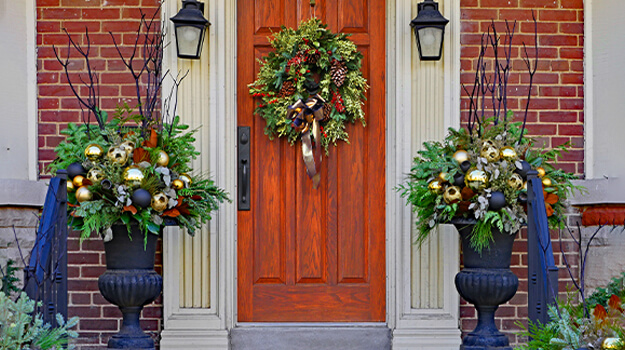
You can make a Christmas evergreen planter using natural or artificial conifer branches. These can be fir, pine, cedar or spruce. A combination of different species always yields a winning result. In fact, this simple arrangement can be enough to create a magnificent, very natural-looking planter.
Here's how to arrange your elements as well as some variations to easily create a true masterpiece in no time.
How to choose a container for your floral arrangement
Pot or planter? The choice of container depends on the location. Before going to the store, consider reusing what you already have.
Often, window boxes, planters or even large pots in which you plant annuals during summer will do the trick perfectly. The hooks and supports are already in place. The window boxes on your windowsills contain old potting soil in which you can easily plant your greenery (if it’s not frozen). Why not take advantage of it? You can always add more pots if needed.
Since your garden disappears under a thick blanket of snow in winter, to create the desired effect, at least one large arrangement should be featured. A large pot can be placed next to the front door, and two others can surround it. These arrangements will set the tone for the smaller ones that will complete your decor.
IMPORTANT: Your pot should be frost-resistant and have drainage holes, especially if it is exposed to the weather. This will prevent water from accumulating in it when it rains or when snow that has accumulated on your arrangement melts with the thaw.
TIP: Make sure your pots won't stain the surface they're placed on. Some metal pots can rust and stain surfaces like concrete or treated wood permanently. Ceramic pots can also stain, especially if water gets trapped or moisture stagnates, which is bound to happen in winter. Place your pots on saucers or raised supports.
What to put at the bottom of the pot
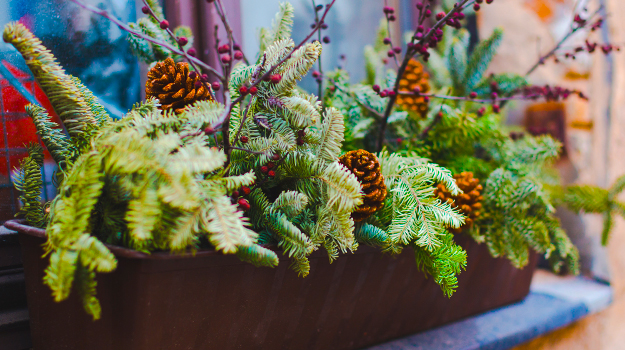
Ensure your containers are stable. Choose containers that are sturdy and wide enough to withstand gusts of wind. If your pot still contains soil, keep it. Otherwise, place rocks, broken pieces of paving stone, or any other heavy material at the bottom of the pot to give it a solid base.
The materials you choose must not block the drainage holes (be careful if you are using pieces of paving), but they must be big enough so they don’t escape through them either (avoid gravel or small rocks that you will have to sweep up every time you move your pot).
TIP: Once you've added weight to it, your pot still needs to be movable. You'll probably need to move it to remove the snow that accumulates.
How to place elements in a Christmas arrangement

Use different types of holiday greenery: fir, pine, cedar, thuja, and blue spruce, if you can find some. This allows you to enjoy a beautiful variety of textures and rich colours. Natural branches will last a long time outdoors and have an appearance that artificial stems don’t always offer.
To achieve a fuller effect at a low cost, you can insert an artificial garland into the top of your pot to create a base into which you can then place the natural branches. You can also combine realistic-looking artificial branches with natural ones. No one will notice a thing!
How long does a cut fir branch keep?
Outdoors, in regions with cold winters, holiday greenery can keep for several weeks, or even several months. Their lifespan depends on the variety, but also on the conditions in which they are kept and the protection they are given against the elements.
In more southern regions, the holiday greenery used in outdoor potted arrangements will only last a few weeks at most (the needles will dry out and turn yellow). You’ll find some interesting alternatives at the end of this article if you live in a warm or temperate climate and prefer not to use artificial greenery.
What to use as a base for your floral arrangement
You can place floral foam (a floral sponge or foam block) in the pot and plant your branches in it. It's also a great way to recycle any polystyrene foam you have at home. These elements will be especially useful in shallower pots or smaller arrangements.
In large pots, using an artificial garland or multiplying the branches (keeping a good length) is usually enough to create a solid base to properly secure the other elements.
How to use holiday greenery
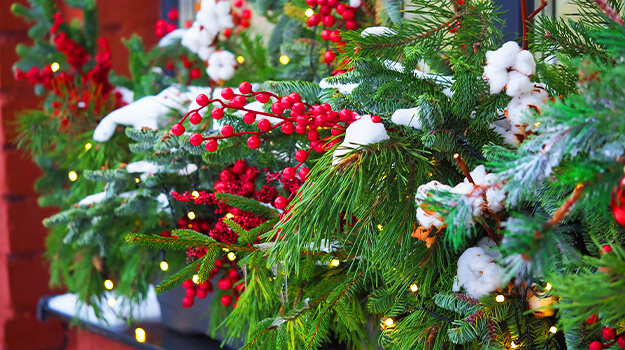
Conifer branches are used as a structural element for your arrangement. First, insert the longest, densest and least flexible branches (fir and spruce) to create structure and volume.
If your pot is taller than it is wide, place them in the centre at the back to create structure and add height to the arrangement. If your pot is very wide, like a window box for example, it's best to play with different heights to create movement and avoid monotony.
On the sides and front, opt for more flexible stems, such as pine or cedar branches, which will create a cascading effect and wrap around the top of your pot. For a natural look, vary the types of conifers.
TIP: If you are planting your stems in polystyrene foam or a floral sponge, use pruning shears to cut the base at an angle so that you can insert them easily.
How to arrange the branches
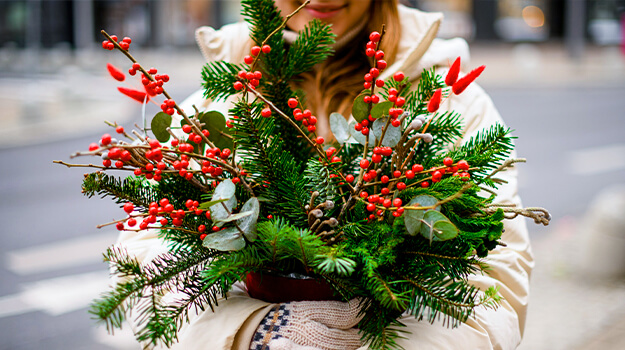
For even more texture and a greater richness of colours, incorporate coloured tree or shrub branches. These branches will serve as filler elements.
What to do with birch branches?
In large pots, use an odd number (usually 3 or 5) of birch branches with a diameter of at least one inch to create a nice balance between the white of their bark and the deep colours of the conifers.
Evergreen shrubs in potted arrangements
You can also use stems from evergreen shrubs that may be growing in your garden. Our favourites: holly, cotoneaster, euonymus, boxwood.
Plants that keep their fruit throughout the winter
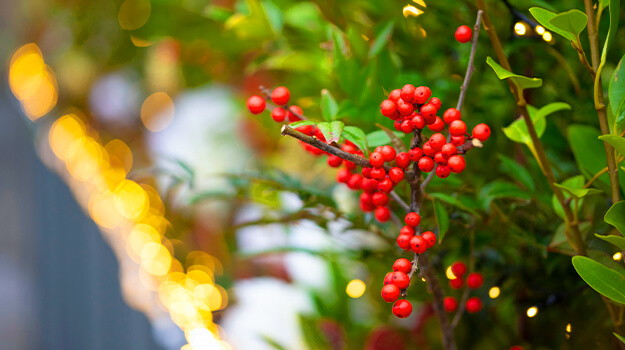
Trees and shrubs that keep their fruit for a long time and whose branches can be used are also interesting. Even without leaves, they offer undeniable appeal. Try these, if the birds haven't already devoured everything: rowan, highbush cranberry, snowberry and rugosa rose. Also consider oak branches bearing acorns. These can sometimes be found on the ground late in the season.
Discover which plants to include in your landscaping for an exceptional winter setting (and to use in your Christmas decorations in the future) here.
Using branches in decorations
Small branches are also a lovely addition to your pots. Some dogwoods have striking yellow or red branches. Other plants, like the corkscrew willow, have a unique appearance that adds fluidity or structure to the arrangement.
If you only have access to fairly ordinary branches, you can keep them as they are, coat them with artificial snow or glitter, or use spray paint to colour them white, red or a metallic colour.
Finally, you can use large branches that ramify to give them the appearance of reindeer antlers. Simply keep more branchlets on one side, trim the ends to shorten them, and sand them to give them a rounded shape.
How to choose which decorations to use in a potted arrangement
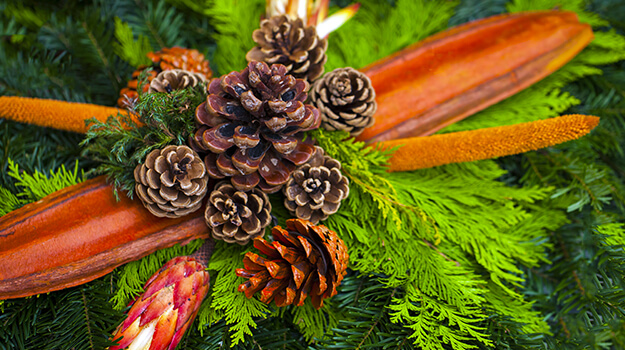
At this stage, you have a beautiful pot made up of natural elements. If you wish, you can incorporate pine cones, vine balls, artificial flowers, Christmas ornaments (find out how to arrange them in our other article), ribbons, etc.
Start by arranging the largest elements, and then the smaller ones. Place your elements in the centre first, moving outwards. This helps to balance everything and create depth.
If necessary, secure the decorations with hot glue, wire or gardening tape. This will ensure that your decorations remain firmly in place when a winter storm hits.
If your pot is large enough, you can also add a feature element in your family’s image: a pair of white skates, wooden skis, rawhide snowshoes, a retro sign with a message...
Finally, add a light source to showcase your creation. LED string lights are a great eco-friendly option since they are long-lasting and energy-efficient. Battery-powered string lights, on the other hand, offer a quick and economical solution.
Tips for a successful outdoor Christmas arrangement in a warm climate (or for an indoor arrangement)
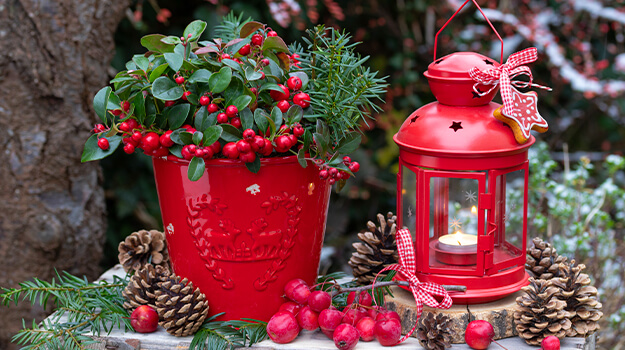
Cut branches dehydrate quickly in hot weather. To prolong the life of your arrangement, place a vase of water in the pot or use floral sponges that you keep moist at all times. If possible, place your pot in the shade, in a cool spot. It will also last longer.
Another easier and much more sustainable option is to create a composition with plants grown in pots (like for your summer pots) rather than cut branches.
Prepare your pots by filling them with quality potting soil, such as our Potting Mix or Moisture Mix, which reduces watering needs and nourishes your plants for up to 3 months. Since you are preparing to plant, do not keep the old potting soil. The nutrients have already been absorbed by the plants grown the previous season.
Replace conifer branches with boxwood, holly, cotoneaster, euonymus, ivy and ferns to enjoy glossy, variegated or nicely cut foliage. Choose blooms with colours that complement your holiday decorations.
Use seasonal flowers like the Christmas rose (in temperate regions) or heat-resistant tropical plants such as poinsettia, ardisia crenata (coral berry) and Christmas cactus. Combine these with plants that have variegated or two-toned foliage: hypoestes, spider plant, anthurium, calathea, caladium, etc.
Read our article to learn how to create a beautiful, balanced composition.


