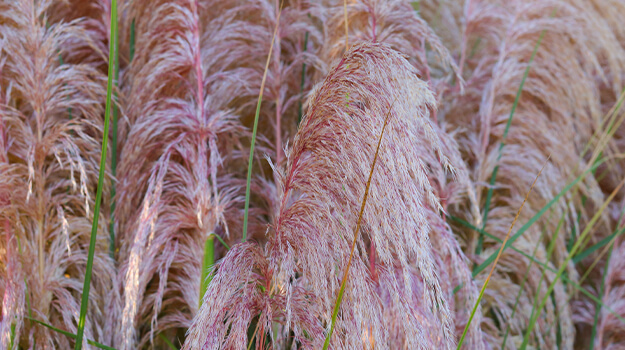
Very popular in urban landscaping, ornamental grasses are becoming increasingly widespread. They are appreciated for their resistance to disease, heat and drought, their appeal lasts beyond the summer months, and they can easily be combined with perennials, annuals, shrubs and more.
Ornamental grasses create spectacular beds, but they can also be used as feature plants, in hedges or as a screen. Some varieties grow in the shade, others in the sun, some are perennials, others annuals. In short, there are ornamental grasses for every taste and every situation. So which grasses should you choose?
Are ornamental grasses invasive?
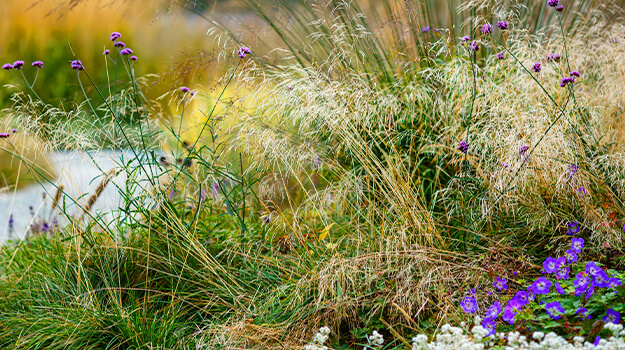
If some gardeners are still hesitant to introduce them into their garden, it is because ornamental grasses have a reputation for being difficult to control.
It's true that some plants quickly invade the space with their rhizomes. However, it's equally true that others will remain obediently in their place. If you don't want to pull your hair out (or grasses) for years, it's best to know which ones to plant.
First of all, you should know that there are three types of ornamental grasses. To make things easier, the plants are classified according to their growth habit.
WARNING
Don't try to grow naturalized ornamental grasses in your garden. Some varieties are invasive species that people are trying to eradicate at all costs. This is the case with the famous common reed (Phragmites australis), which grows along hundreds of kilometers of highway and invades wetlands.
Avoid propagating it. Even using it in your fall decorations poses a risk of unintentional propagation, which could make matters worse.
Bunch grasses: non-invasive ornamental grasses
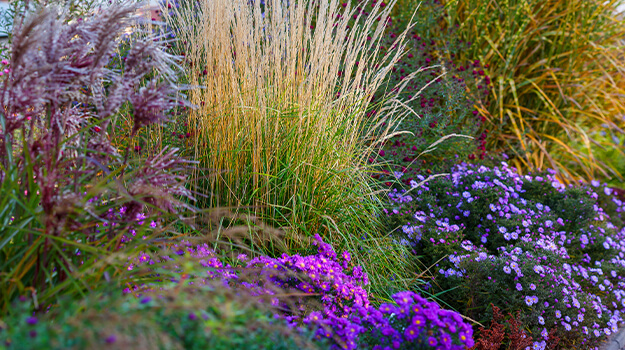
Bunch grasses are non-invasive varieties that grow in clumps and do not spread by rhizomes. Depending on the variety, they can reach impressive sizes over time, but they never spread beyond their original location. Like all good perennials, when they become too large, simply divide them.
TIP: Well, "simply" may not be the right word, as dividing a large grass plant can be a difficult task. You can use a sharp, sturdy spade, or a sharp knife, hatchet or axe. It is recommended to dig up the entire root ball, but if it is not possible, you can also divide the plant by removing certain sections.

Bunch grasses include…
- Blue oat grass (Helictotrichon sempervirens) - zone 4
- Feather reed grass (Calamagrostis x acutiflora) - zone 4
- Tufted hairgrass (Deschampsia cespitosa) - zone 3
- Blue fescue (Festuca glauca) - zone 3
- Moor grass (Molinia arundinacea) - zone 4
- Corkscrew rush (Juncus effusus Spiralis) - zone 4
- Purple moor grass (Molinia caerulea) - zone 4
- Chinese silver grass (Miscanthus sinensis) - zones 4, 5 or 6
- Purple flame grass (Miscanthus sinensis Purpurascens) - zone 4
GOOD TO KNOW
Purple flame grass is a bunch grass that does not invade the garden. Not to be confused with Miscanthus sacchariflorus, which is part of a different category and is very invasive.

Creeping grasses: invasive ornamental grasses

Creeping grasses have the particularity of growing by means of rhizomes that move horizontally in the upper layers of the soil. Individual plants emerge from these long roots. A new plant can thus reappear at a distance from the one you planted, then another and another.
Creeping grasses can grow at an impressive rate and can quickly invade a flower bed, but also a lawn, a hedge, etc. As they quickly get out of control, it is best to plant them in an area that can control them... such as a flower bed surrounded by concrete surfaces!
TIP: Some gardeners choose to plant them in a large pot sunk into the ground. The bottom is removed so that the water doesn't get trapped, and the top of the pot is left above the surface to prevent the plant from invading its environment. Be careful, though… Some rhizomes can still escape!

Here are a few creeping grasses you should avoid:
- Smooth brome (Bromus inermis Skinner's Gold) - zone 3
- Orchard grass (Dactylis glomerata Variegata) - zone 5
- Sand ryegrass (Leymus arenarius Glaucus) - zone 4
- Japanese blood grass (Imperata cylindrica Red Baron) - zone 5
- Miscanthus sacchariflorus - zone 3
- Cattail (Typha spp.) - zone 3
- Ribbon grass (Phalaris arundinacea Picta) - zone 3
- Common reed (Phragmites australis) - zone 3
- Giant Chinese silver grass (Miscanthus giganteus) - zone 4
Short-rhizome grasses: ornamental grasses that can be controlled
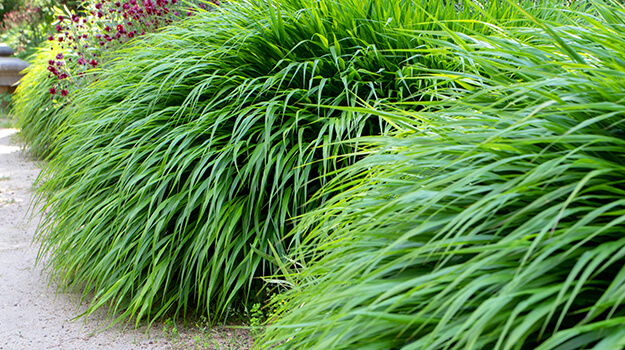
Halfway between ornamental grasses that remain in the same place their entire life and those that are unruly, these are varieties that grow in clumps but which can also produce offshoots close to the mother plant from short rhizomes.
They are an interesting option for gardeners who aren’t too nervous. All it takes is a shovel to stop their expansion plans... and get a brand new plant for free!
Varieties you should try…
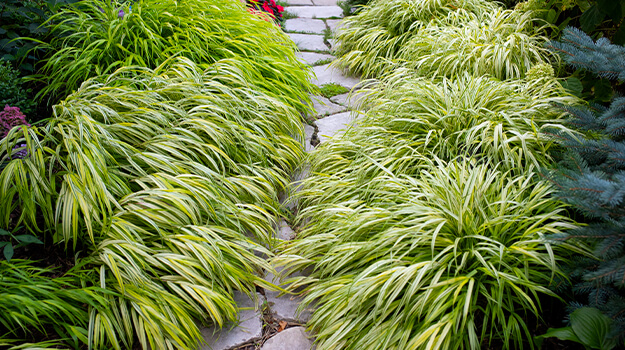
- Hakonechloa (Hakonechloa macra) - zone 4b
- Switchgrass (Panicum virgatum) - zone 3
- Prairie cordgrass (Spartina pectinata Aureomarginata) - zone 4
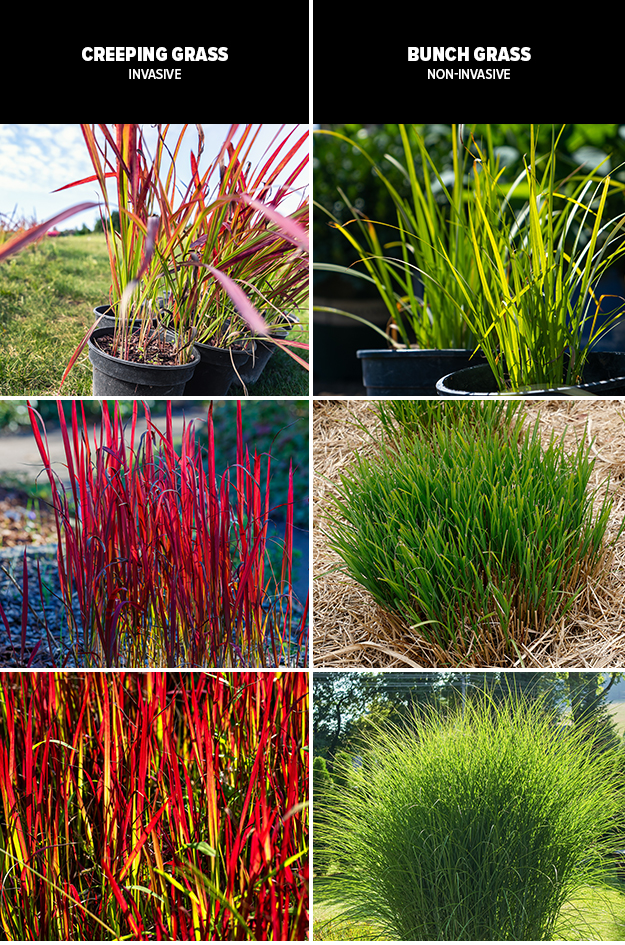
TIP: You found a ornamental grass at the garden centre that isn't listed in our guide and you’re hesitant to buy it? A good way to determine if the variety will be invasive is to observe how it grows in its pot. If the plant grows in a clump, it will most likely behave the same way in your garden. If, on the other hand, it appears to be composed of single stems, it is a creeping and invasive grass.
Ornamental grasses that self-seed in mild climates
In addition to creeping varieties, self-seeding varieties can quickly become a problem in the garden. In northern regions, there aren’t that many, but in mild climates, they can quickly get out of control. Here are some plants to watch out for.
- Mexican feather grass (Stipa tenuissima) - zones 6b to 10
- Pampas grass (Cortaderia selloana) – zones 8 to 10
- Chinese silver grass (Miscanthus sinensis) - zones 4 to 9 (in more southern regions)
- Purple flame grass (Miscanthus sinensis Purpurascens) - zones 4 to 9 (in more southern regions)
- Miscanthus sacchariflorus - zones 3 to 9 (in more southern regions)