
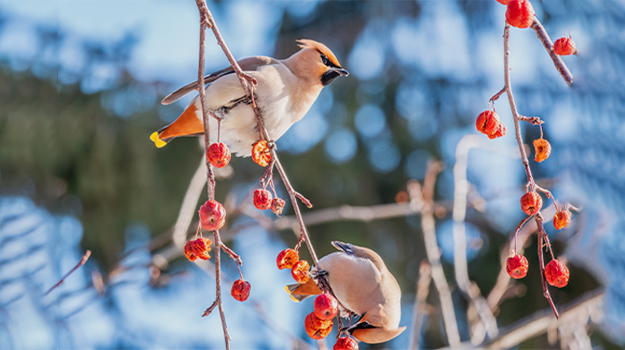
Winter is a great season for attracting birds. Let’s face it, there isn’t much to do in the garden at this time of year, but you can still feel connected with your garden by meeting the birds’ needs and observing their activities.
The birds might be struggling due to the cold temperatures, storms and scarce food supplies. All you need to do is to provide a few basic things to attract birds that will eventually call your garden home: food, water and shelter.
What plant attracts the most birds?
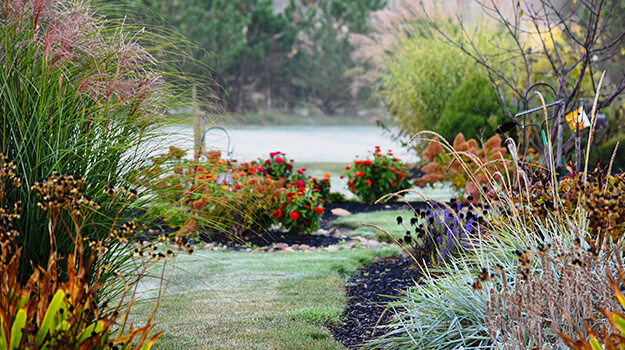
By planting native trees and shrubs, you help provide better-suited and more nutritious food for local birds and pollinators. Many plants produce nectar-rich flowers and fruits at times of the year when they are most needed.
Read our article to learn more about the plants that attract pollinators.
But that's not all. Native plants also provide shelter for birds that spend the winter with us, seeking refuge from the cold and snow. By planting native plants, you create a bird-friendly landscape that thrives year-round.
The first thing to do to encourage birds to visit us is to put off garden cleanup until next spring.
Simple and eco-friendly, this practice also helps protect your plants during the cold season. Those who love immaculate gardens might be tempted to collect and compost dried flowers, seeds and fallen berries. However, this would eliminate an essential and readily available food source for migratory birds as well as those that overwinter with us.
To discover other ways to attract birds to the garden, check out: Four Ways to Attract Backyard Birds this Winter - Birds Canada | Oiseaux Canada
Do birds need to be fed in the winter?
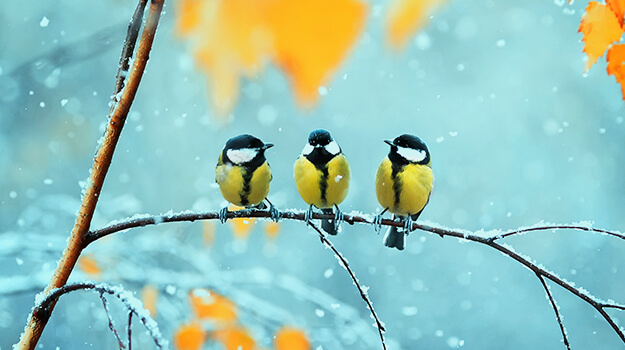
Birds that stay in northern regions in winter can find food in nature. By feeding them, we are just making life easier for them.
In winter, for example, blue jays feed on berries, seeds, nuts and grains that they can still find in the garden. To cope with the cold season, however, they need foods rich in fats and will also feed on insects, larvae and, sometimes, carrion. In fact, some birds build up reserves that they can draw on when insects become scarce.
It goes without saying that the suet balls we prepare for them are particularly appreciated at this time of year.
Is it okay to stop feeding birds in winter?
Contrary to what we sometimes hear, feeding birds in winter does not create dependency and has no impact on their migratory cycle. On the contrary, if you are in the habit of filling your feeders during the warmer months, it is recommended to continue doing so in winter.
Birds don't limit themselves to a single feeder. Rather, they establish a circuit that they repeat day after day. When a feeder included in their circuit stops being stocked, it complicates their lives.
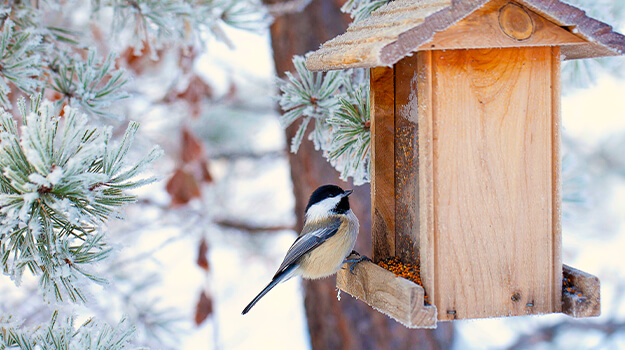
When a food source suddenly disappears, birds must find a new one. This can be a difficult task for a bird trying to survive our Canadian winter.
For more information, check out: How to help local bird populations - David Suzuki Foundation
TIP: You installed a new birdfeeder in your garden, but haven’t seen any birds yet? It usually takes weeks before birds recognize and frequent a new feeding station. It’s normal. Note that the best place for your birdfeeder is near a sheltered area (such as a bush) that provides a quick escape. It will increase the visitation.
What is the best thing to feed birds in the winter?
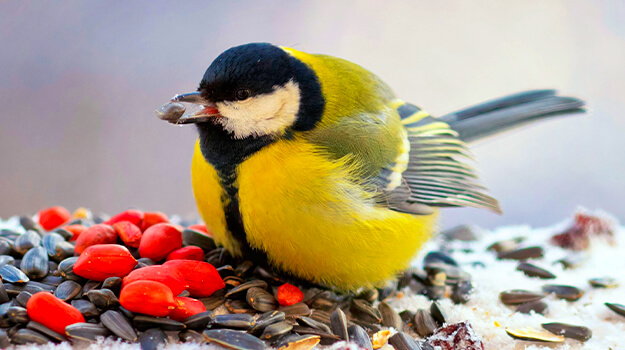
If you plan to feed the birds all winter, choose the type of food that suits them.
Different birds have different food preferences, gravitate to different types of feeders and even different feeding station locations. If you are just starting and want only one basic feeder, then install one that offers a cover and side protection of food, as well as a perch.
Bread, peanut butter and apples are low in nutrients. Birds that eat these foods may suffer from malnutrition and are more susceptible to disease. Offer black sunflower seeds, suet and shelled peanuts instead. These are better options.
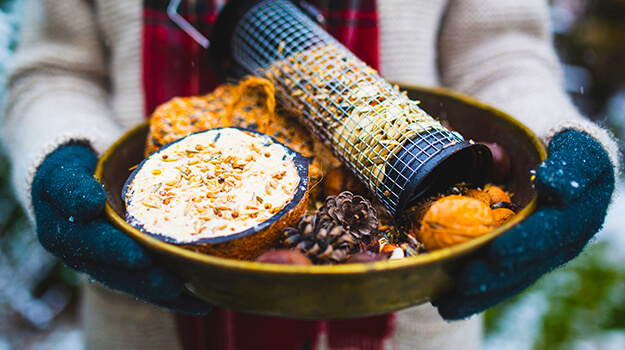
A good all-purpose feed is black sunflower seed. This feed will satisfy a wide spectrum of bird types. Position this feeder near a shrub or tree, to give the shy birds a place of security. It is not recommended to place any feeders near windows, as that will encourage accidental collisions.
To attract a more diverse set of visitors, consider installing suet feeders (for woodpeckers), tube-type nyger seed feeders (for goldfinches, house finches, pine siskins, etc.) and open-tray feeders close to the ground (for mourning doves, juncos, sparrows, towhees, etc.). If squirrels are unwanted visitors, then you can install squirrel baffles, or feeders designed to keep out squirrels.
Try our recipe to make your own suet balls at home.
Should you provide water for birds in winter?
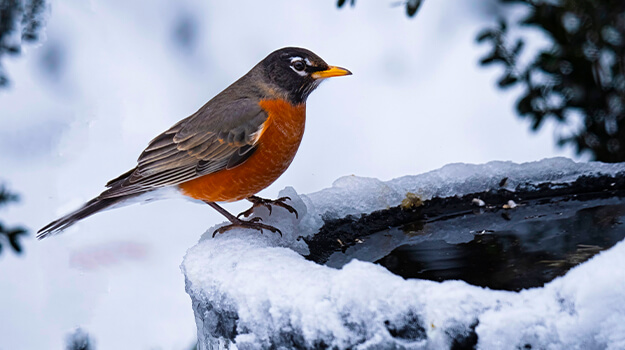
In winter, open water is a bird magnet. If you provide a heated bird bath, you’ll be surprised with many birds that wouldn’t normally stop at feeders. And keep refreshing the water and keep it clean.
Again, as with bird feeders, place the bird bath near shrubs or trees to provide a spot for their refuge from aggressive birds. This is not a must-have, as birds will eat snow, but if you have the time, setting up a winter bird bath is well worth the effort.
How to provide shelter for birds in the winter
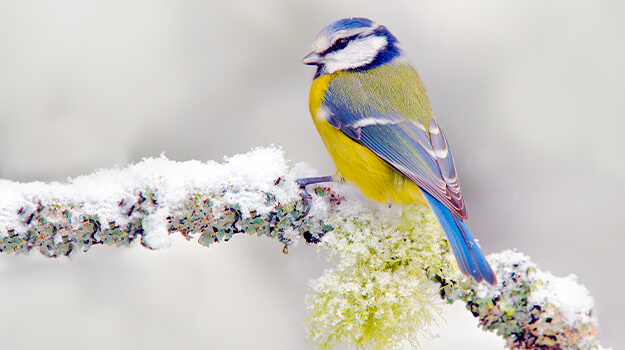
You’ll need to offer a cozy place to roost during the winter to keep your backyard birds secure and comfortable even in the worst weather. This is where your backyard trees, shrubs and hedges come in useful. Evergreen types provide an even better shelter for them.
If your backyard has very few of these plants, consider planting some in the future. Birds appreciate fruit-bearing trees and shrubs like crabapple, cherry, serviceberry, currant, honeysuckle, dogwood, etc.
In the absence of suitable plant shelters, there are bird shelter boxes that can be purchased or built. Compared to birdhouses, these shelter boxes don’t have drainage and ventilation holes, in order to conserve more heat.
They usually have an entrance hole near the bottom instead of the top to prevent rising heat loss. Also, in the interior, there are perches to comfortably accommodate greater numbers of birds as well as scored walls or interior mesh to help the birds cling and climb safely. They tend to have larger than typical dimensions to accommodate more birds and thicker walls for better insulation in winter.
Attracting and feeding birds is a rewarding experience for you and the kids. Research has shown that backyard feeders benefit the overall survival of wintering birds. The birds make it through the winter in better physical condition, and those benefits do carry over into the spring nesting season. Just try to keep the feeders full, and they will keep coming back.
TIP: Clean out the birdhouses after nesting season to prevent the spread of disease.
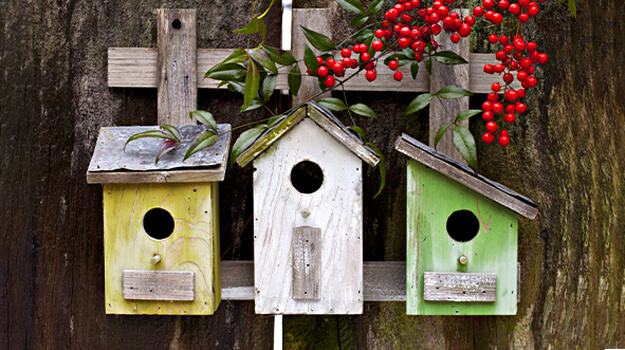
How to winterize a birdhouse?
It is possible to winter-proof your birdhouse by sealing the ventilation and drainage holes. It will keep warm air inside. To seal holes, use rags, hay, foam weatherstripping, duct tape (on the outside). You can use any material you have that will prevent the wind from entering the birdhouse.
Inviting birds to the garden is a wonderful way to bring life and color during the long months when the garden is buried under snow. Discover our article on the art of winter landscaping to design an exceptional garden twelve months a year.
